


Chafing (31 July 2018)
Published August 1, 2018 | By admin

Chafing (31 July 2018)
What is Chafing?
Chafing is damage to the skin caused by repetitive rubbing. A chafed area is basically a painful, bleeding scratch mark where your sweaty, salty skin has rubbed against your clothing or even against itself. The chafed area will be red, raw, and tender.
When you sweat, the moist skin is more prone to damage. Salt crystals form when sweat evaporates, adding grit that can cause more friction and chafing. Hot weather is a high-risk time for chafing due to sweating, but you can also chafe in cold or dry weather.
Every Tuesday on
East Coast Drive with Bongani and Mags
between 16h40 & 16h50

Areas Prone to Chafing
- Armpits
- Groin
- Under-breast area & Nipples (especially amongst Runners)
- Inner thighs (being prime chafing area)
If you have any rolls of fat or sagging skin you may experience chafing in the folds where it is moist and skin rubs on skin. You can get extra friction in those areas when you exercise due to repetitive motion, leading to chafing. However, you can be toned and trim and still need to take measures to prevent chafing.
Solutions for Armpit Chafing
The armpits are a prime area for chafing due to your sweat glands.
- Try an antiperspirant that dries into a powder. This will not only keep you dry, it prevents the skin tackiness you can get with deodorant stick.
- Avoid armpit hair stubble, which can lead to chafing. Either let your armpit hair grow or ensure it is freshly shaved.
- Lubricate your armpits well before workouts. A silicone-based lubricant is especially good for this area, and it won't stain your shirts.
- Wear shirts that fit well in the armpits, without bunching. Look for seamless sleeves or those with flat seams.

Solutions for Groin Chafing
Men are especially prone to groin chafing, but it can affect women as well. Take these steps:
- Apply lubricants generously to the groin area before you run, walk, or bike. You may need to reapply them during long workouts. Avoid the vagina or urethral opening as you may feel stinging or irritation from some lubricants in these area.
- If you wear briefs or bikini underwear with elastic at the leg openings, be sure to lubricate those areas.
- Wear snug but not overly-tight workout shorts. Avoid shorts that will bunch up around the groin. Look for seamless shorts.
- Cyclists should wear bike shorts that have a built-in chamois, which wicks moisture away from the skin, and apply a lubricant to groin area as well.
- Pubic hair stubble can contribute to chafing, so either go natural or keep the area well-depilated.
Solutions for Chafing of Nipples and Under Breasts
Use these steps to prevent painful chafing:
- Cover your nipples to keep them from rubbing against your shirt. Wear a Good Quality Fitting Sports Bra.
- Keep your under-breast area dry by using an absorbent body powder.
- Lubricate the areas where your bra straps rub against the skin.
- Choose sports bras that have a soft fabric covering over the elastic and that have wide straps.
Solutions for Chafed Thighs
If you have experienced chafed thighs, use the prevention tactics in these ways:
- Start by keeping the area dry. You can use body powder or a sports powder to ensure extra protection.
- Choose tights or light compression shorts that will protect your skin. Be sure they have flat seams or are seamless.
- For women Running Skorts (latest trend) often have these shorts built-in. They should be made of sweat-wicking fabric, not cotton, if you are going to be exercising and sweating.
Previous Tips and Podcasts
- Five 2018 Exercise Trends (24 July 2018)
- Q&A session with Phindi (17 july 2018)
- Heatstroke Prevention (10 July 2018)
- Heatstroke (3 July 2018)
- The Benefits of Cross-Training (19 June 2018)
- Exercise Myths about Weight Loss (20 March 2018)
- Top 10 Reasons to Stretch After a Workout (13 March 2018)
- Exercise and Personal Hygiene (6 March 2018)
- Having a Healthier Relationship with Your Body (20 Feb 2018)
- Your Fitness - Your Relationship (13 Feb 2018)
- 5 Signs you Might be Deficient in Vitamin B12 (6 Feb 2018)
- 4 Ways to Use Breathing Techniques to Get a Better Workout (30 Jan 2018)
- Six Tips for Training in Hot Weather (23 Jan 2018)
- The 5 Main things holding you back from achieving your fitness goals (16 Jan 2018)
Five 2018 Exercise Trends (24 July 2018)
Published July 24, 2018 | By admin
Five 2018 Exercise Trends (24 July 2018)
Every Tuesday on
East Coast Drive with Bongani and Mags
between 16h40 & 16h50
1. HIIT – High-intensity interval training
HIT is simply entails alternating between short intervals of high- and low-intensity activity. So if you’re jogging at a steady pace, sprint intermittently for 30 seconds. Sounds exciting but be mindful that vigorous activity increases the risk of injury, so if you’re not sure how physically fit you are, it’s best you get a physical exam before you jump on it.
2. Bodyweight training
It’s the best way to avoid pricey gym memberships because all you need is your body. Bodyweight training works multiple muscles at the same time. Your MUST know what are doing!!!!!

3. Strength training
It’s has been around for ages, so we can hardly call it a new trend, but rather a form of training that’s here to stay. We’re way past that period where the weights section at the gym was a men’s only section. More women are starting to stack those barbells as they squat, deadlift, and lunge.
Strength Training also includes bench presses, push-ups, pull-ups, and core exercises (planking, ab rolling, hanging leg raises).
4. Heated fitness classes
Hot Yoga was the first of this kind and heated cycling studios have been around in the US for a few years now. This new attraction to heat training is based on the fact that being drenched in sweat within minutes of training creates the feeling of a more fulfilling workout.
But be careful not to exercise in a room where the temperature has been cranked up too high because it may result in heat stroke. Not ideal.
5. Boxing
This is a highly recommended form of stress relief for women. Not only does it take your mind off things, but throwing punches at a bag or in the air also works out your whole body.
There are a variety of options to try out, from kickboxing and boutique boxing to mixed martial arts. It really all depends on how tough you consider yourself to be.
Previous Tips and Podcasts
- Q&A session with Phindi (17 july 2018)
- Heatstroke Prevention (10 July 2018)
- Heatstroke (3 July 2018)
- The Benefits of Cross-Training (19 June 2018)
- Exercise Myths about Weight Loss (20 March 2018)
- Top 10 Reasons to Stretch After a Workout (13 March 2018)
- Exercise and Personal Hygiene (6 March 2018)
- Having a Healthier Relationship with Your Body (20 Feb 2018)
- Your Fitness - Your Relationship (13 Feb 2018)
- 5 Signs you Might be Deficient in Vitamin B12 (6 Feb 2018)
- 4 Ways to Use Breathing Techniques to Get a Better Workout (30 Jan 2018)
- Six Tips for Training in Hot Weather (23 Jan 2018)
- The 5 Main things holding you back from achieving your fitness goals (16 Jan 2018)
Q&A session with Phindi (17 July 2018)
Published July 18, 2018 | By admin
Q&A session with Phindi (17 July 2018)
Every Tuesday on
East Coast Drive with Bongani and Mags
between 16h40 & 16h50
Our approach to fitness and wellness shouldn’t be in a form of "an event”, it should be a lifestyle. A lifestyle is part of your everyday life, it’s seldom weather dependent. Phindi Gule tackles a Q&A session with a few interested health advocates.

Natalie Smit - Hillcrest
QUESTION:
Every winter I can’t seem to get myself out of the house for an exercise routine. My energies tend to run low, and lethargy sets in. This affects my general wellbeing, how can I overcome this?
ANSWER:
Weather:
Remember flowers need both Rain and Sun to grow. The same applies to human beings, we’ve got to survive both Winter & Summer. You simply need the 3D’s - DETERMINATION, DEDICATION & DISCIPLINE.
Health:
Being consistent with your exercise routine has a lot of benefits ESPECIALLY during winter. Cold and Flu is something prevalent during the winter season, now exercising even during the winter will help boost your immune system and your body will be less prone to Cold or Flu. An intake of supplements such as Immunizer can also help boost your immune system.
Lifestyle:
Our approach to Fitness & Wellness shouldn’t be in a form of "an event” it should be a Lifestyle. A lifestyle is part of your everyday life (WAY OF LIVING), it’s seldom weather dependent.
Zoleka Mcoyi - Morningside
QUESTION:
What are my options if I don’t feel like going to Gym or being outdoors for training during winter?
ANSWER:
If you look around, a lot of what we do at Gym can be done at home - so home exercise is always a winner. Body Weight Exercise is one of the trending form of exercises in 2018 and that can be done at home. We also need to start being creative and realistic about our schedule, commitments and our normal day to day activities.
Some of the Things to Do:
- Never use a Lift or Escalators unless you MUST (e.g got a trolley)
- When seated, lift both your legs (have them horizontal to the ground) HOLD the position for 30 seconds…rest for 10sec (try do 10 of those per day). GOOD FOR THIGHS
- Instead of a Chair, use a Stability Ball as your office chair. This will help strengthen your Core.
Previous Tips and Podcasts
- Heatstroke Prevention (10 July 2018)
- Heatstroke (3 July 2018)
- The Benefits of Cross-Training (19 June 2018)
- Exercise Myths about Weight Loss (20 March 2018)
- Top 10 Reasons to Stretch After a Workout (13 March 2018)
- Exercise and Personal Hygiene (6 March 2018)
- Having a Healthier Relationship with Your Body (20 Feb 2018)
- Your Fitness - Your Relationship (13 Feb 2018)
- 5 Signs you Might be Deficient in Vitamin B12 (6 Feb 2018)
- 4 Ways to Use Breathing Techniques to Get a Better Workout (30 Jan 2018)
- Six Tips for Training in Hot Weather (23 Jan 2018)
- The 5 Main things holding you back from achieving your fitness goals (16 Jan 2018)
Heatstroke Prevention (10 July 2018)
Published July 12, 2018 | By admin
Heatstroke Prevention (10 July 2018)
Whether you have a heart condition, are elderly and obese or young and athletic, it's important to take steps to prevent heat stroke. Experts recommend these strategies:
Every Tuesday on
East Coast Drive with Bongani and Mags
between 16h40 & 16h50
1. Try to avoid being outdoors during the hottest part of the day:
Instead of mowing the lawn in the middle of the day when it's 35 degrees, try doing it early morning or later in the day. Sports teams take this advice; many of them practice early in the day rather than in the middle of the day, when temperatures are highest. Some people, like construction workers or traffic officers, have no choice as to when they work. If you're exercising or working in the heat, modify your work-to-rest ratio depending on the environmental conditions.

2. Drink lots of water:
Hydration is the single most important aspect of heat stroke prevention, since sweating is the most important mechanism our bodies have to get rid of heat. Make sure you take some snacks with your water intake. Drinking too much water without consuming any electrolytes – such as calcium, potassium and magnesium – can dilute the body's sodium, leading to such problems as headache, nausea, vomiting, muscle spasms and seizures. Eating a snack while drinking water is the safest way to go.
3. Wear loose-fitting, light-colored clothing:
You're better off wearing clothes that are loose enough to allow breezes to pass through. Same goes for light-colored clothing, which absorbs less heat than dark-colored items. Wear a hat with a brim that shields the sun from your face.
4. Take frequent breaks:
If you have to be outdoors during the hottest part of the day, take as many opportunities as you can to get out of the heat. If there's an air-conditioned public building nearby, go inside for a few minutes. Shade is another option – if it's available, spend as much time as you can in it, as opposed to being in the sun. One of the best options for people who play team sports is to cool down with cold and wet towels during any opportunity when the sport presents a break during a game or practice or at halftime.
Previous Tips and Podcasts
- Heatstroke (3 July 2018)
- The Benefits of Cross-Training (19 June 2018)
- Exercise Myths about Weight Loss (20 March 2018)
- Top 10 Reasons to Stretch After a Workout (13 March 2018)
- Exercise and Personal Hygiene (6 March 2018)
- Having a Healthier Relationship with Your Body (20 Feb 2018)
- Your Fitness - Your Relationship (13 Feb 2018)
- 5 Signs you Might be Deficient in Vitamin B12 (6 Feb 2018)
- 4 Ways to Use Breathing Techniques to Get a Better Workout (30 Jan 2018)
- Six Tips for Training in Hot Weather (23 Jan 2018)
- The 5 Main things holding you back from achieving your fitness goals (16 Jan 2018)
Heatstroke (3 July 2018)
Published July 12, 2018 | By admin
Heat Stroke (3 July 2018)
Heat Stroke occurs when the body overheats and reaches an inner core temperature of 104 degrees or higher. It can attack fit, athletic young men and women who were pushing themselves to achieve a good time on the race. It can also happen when people spend a lot of time in the sun - in this case - people who will be prone to it are elderly and obese people.
Every Tuesday on
East Coast Drive with Bongani and Mags
between 16h40 & 16h50
Two Types of Heat Stroke (Exertional and Non-Exertional Heat Stroke)
There are two kinds of heat stroke: exertional, which is associated with vigorous physical activity, and non-exertional which can be caused by too much sun exposure (without being active).
Heat Stroke Symptoms
Whether heat stroke strikes while you're doing physical labor in the heat or simply sitting in the sun on an unusually hot day - the symptoms are mostly the same. These symptoms include a high body temperature, nausea, vomiting, rapid breathing, flushed skin, headache, a racing heart rate, confusion, agitation, slurred speech and irritability. Heat stroke can also lead to seizures and a coma.
What to Do for Heat Stroke?
Immediate heat stroke treatment involves cooling the victim's body as soon as he or she shows signs of distress. Dousing the person with cold water from a hose or putting him or her in a cold shower can be effective. Wrapping a heat stroke victim in cold towels is also a good measure. Cooling the body of a heat stroke victim is crucial to reduce damage to the person's brain and vital organs.
Previous Tips and Podcasts
- The Benefits of Cross-Training (19 June 2018)
- Exercise Myths about Weight Loss (20 March 2018)
- Top 10 Reasons to Stretch After a Workout (13 March 2018)
- Exercise and Personal Hygiene (6 March 2018)
- Having a Healthier Relationship with Your Body (20 Feb 2018)
- Your Fitness - Your Relationship (13 Feb 2018)
- 5 Signs you Might be Deficient in Vitamin B12 (6 Feb 2018)
- 4 Ways to Use Breathing Techniques to Get a Better Workout (30 Jan 2018)
- Six Tips for Training in Hot Weather (23 Jan 2018)
- The 5 Main things holding you back from achieving your fitness goals (16 Jan 2018)
The Benefits of Cross-Training (19 June 2018)
Published June 19, 2018 | By admin
The Benefits of Cross-Training (19 June 2018)
Every Tuesday on
East Coast Drive with Bongani and Mags
between 16h40 & 16h50
1. Conditioning
Whether you main choice of exercise is running, cycling, swimming triathlon strength training or beyond - you need cross training in your life. Cross training is training in more than one sport or form of exercise in order to improve fitness in your main sport and help prevent injury.
By performing a variety of exercises from different disciplines, you are asking more of your body than with a traditional, straightforward approach. Increased workload and variety lead to increased capability. In other words, by doing more with your body, your athletic and fitness levels have no choice but to grow.
Cross-training workouts aren’t tailored to a single goal, such as gaining strength or getting faster, but cater to these needs simultaneously. With cross-training, it’s possible to gain muscle, lose fat, increase cardio-aerobic capacity and quicken your feet - all in a single workout. This comprehensive style of fitness training is called CONDITIONING, and it’s one of the benefits of cross-training. Here’s how Cross Training can benefit you.

2. Injury prevention
Often when we get injured in the gym, on the court, or on the field, it’s because they’re over doing a single activity. Whether it be running, squatting, cutting, or jumping, your body is easily worn down. Joints, ligaments, muscles and tendons throughout your body are under a tremendous amount of stress though repeated movement, and it’s important to give them the occasional break.

3. Active recovery
Active recovery is the practice of using an alternative type of training to recover from your primary training method. For instance, many professional athletes do swimming workouts and pool resistance exercises to actively recover from their on-field practices and traditional weight room training. In addition to the conditioning and injury preventing benefits of active recovery, it has been show to actually speed up recovery by increasing blood flow and the delivery of nutrients to stressed or damaged muscle tissue.
Try this sample cross-training workout to kick-start your new routine or break through a fitness or athletic plateau (cycle through the listed exercises in order 3 times and try to complete the workout with as little rest as possible):
- 10 pushups
- 25 jumping jacks
- 8 pull-ups
- 30 seconds jump rope
- 10 squats with 70% of your body weight
- 60 seconds plank hold (prone-bridge)
- 20 box jumps on 25-inch platform
- 100 meter sprint (or 15 seconds of fast paced running)

Previous Tips and Podcasts
- Exercise Myths about Weight Loss (20 March 2018)
- Top 10 Reasons to Stretch After a Workout (13 March 2018)
- Exercise and Personal Hygiene (6 March 2018)
- Having a Healthier Relationship with Your Body (20 Feb 2018)
- Your Fitness - Your Relationship (13 Feb 2018)
- 5 Signs you Might be Deficient in Vitamin B12 (6 Feb 2018)
- 4 Ways to Use Breathing Techniques to Get a Better Workout (30 Jan 2018)
- Six Tips for Training in Hot Weather (23 Jan 2018)
- The 5 Main things holding you back from achieving your fitness goals (16 Jan 2018)
DurbaNite Race – 9 June 2018
Published June 5, 2018 | By admin

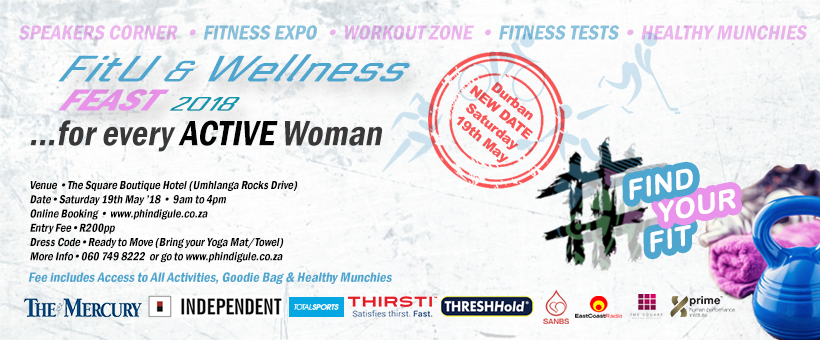
FitU & Wellness Feast 2018 – Durban – 19 May 2018
Published May 19, 2018 | By admin
Exercise Myths about Weight Loss (20 March 2018)
Published March 20, 2018 | By admin
Exercise Myths about Weight Loss (20 March 2018)
Every Tuesday on
East Coast Drive with Bongani and Mags
between 16h40 & 16h50
Exercise Myths – #1: The more you sweat, the more kg's you will drop.
Fact: Weight loss is not about sweating. It’s about burning calories.
What matters most about losing weight is that at the end of each day you’ve burned more calories than you’ve eaten. You want more calories (energy) “going out” than “going in.”
Sure, if you sweat up a storm, you’ll lose a kg's or two in water, but it’s temporary. Those kg's go right back on. That’s because sweat has little to do with calories burned. Sweat happens simply because your body’s storing heat, whether while exercising or sunbathing, and you need to cool off.
So if running – and profuse sweating – isn’t your thing, that’s fine. Walk if you prefer. What is associated with calories burned is the total number of steps you take each day. An effective goal for most people is about 10,000 steps (7 - 8km's) every day.

Exercise Myths – #2: You can burn more calories while walking by carrying free weights or wearing ankle or wrist weights.
Fact: Using weighted items during aerobic exercise could actually ruin your best efforts to burn calories.
Using weights while walking or jogging can alter your normal gait and body mechanics, placing strain on ligaments, tendons, and joints. “The strain exposes you to a heightened risk of injury, which means you might end up on the couch, in pain, and burning no calories.
Weights can be a great part of your fitness routine when used for your strength training sessions – separate from your aerobic sessions.

Exercise Myths – #3: No pain, no gain.
In other words, no pain no weight loss - WRONG!!!!
Moderate intensity physical activity makes you breath harder and may make it more difficult to talk, but you should be able to carry on a conversation while exercising. This is unlike vigorous physical activity, which will make you completely out of breath and will make you sweat profusely regardless of the weather condition.

Exercise Myths – #4: You can target one area, like belly fat, and get rid of it (at least that’s what ads tell us).
Fact: Gimmicks like the Ab Blaster look too good to be true… and they are.
There’s no such thing as “spot reduction” – except in media hype. It is physiologically impossible to lose fat in one specific area. Losing fat in the belly, hips, butt, and everywhere else does happen, but only because you’ve created an energy deficit, that, is, you’re burning more calories than you’re eating. The best – and only scientifically proven – way to do that is with lifelong healthy habits – a fiber-rich, low-calorie-dense eating plan and regular (ideally, daily) exercise.
So hang in there, dedicate time every day for aerobic workouts in your training heart rate zone. And two to three times weekly, target all your major muscle groups with some strength training exercises for that strong core. Equally important, eat well – lots of fresh fruits, vegetables, beans, and whole grains every day. You will lose excess fat, wherever it is on your body.

Previous Tips and Podcasts
- Top 10 Reasons to Stretch After a Workout (13 March 2018)
- Exercise and Personal Hygiene (6 March 2018)
- Having a Healthier Relationship with Your Body (20 Feb 2018)
- Your Fitness - Your Relationship (13 Feb 2018)
- 5 Signs you Might be Deficient in Vitamin B12 (6 Feb 2018)
- 4 Ways to Use Breathing Techniques to Get a Better Workout (30 Jan 2018)
- Six Tips for Training in Hot Weather (23 Jan 2018)
- The 5 Main things holding you back from achieving your fitness goals (16 Jan 2018)
Top 10 Reasons to Stretch After a Workout (13 March 2018)
Published March 13, 2018 | By admin
Top 10 Reasons to Stretch After a Workout (13 March 2018)
So often stretching after exercise is overlooked, when if fact, it should be seen as part of your session. Your body will thank you for that quiet time on the mat. “Stretching can help increase blood flow to those exerted muscles, which can help alleviate future soreness,” says Rowley who advocates holding each light stretch for about 20 seconds. Trust: It'll make getting out of bed the next morning so much easier.
Every Tuesday on
East Coast Drive with Bongani and Mags
between 16h40 & 16h50
1. Stiffness and Soreness
During a hard workout, muscles go through numerous contractions which leave them in a miss-shaped and shortened state, which is why you will feel stiffness and soreness if you don’t try and rectify the state by stretching.

2. Lactic Acid
Your body produces lactic acid which makes your muscles tired and sore, stretching helps to eliminate the lactic acid.

3. Endorphins
Endorphins are released after a workout once your body starts to cool down, stretching helps slow the cooling process ensuring you feel energised after your workout.

4. Blood Flow
Stretching helps the blood flow back into your muscles at a more regulated pace, allowing your heart rate to come back to normal, your muscles feed on oxygen and nutrients brought in by the blood

5. Lower Back Pain
The most common complaint amongst active people is the lower back area. Nine times out of ten stretching the hamstrings and hip flexors, muscles that are attached to the pelvis, will relieve that pain.

6. General Posture
General posture is improved, people tend to stand up straighter particularly if you focus on stretching backs, shoulders and chests

7. Tension and Anxiety
General tension and anxiety lead to tension in your muscles, whether that’s stiff necks or tight shoulders. Releasing and stretching those muscles often leads to an overall feeling of stress relief.

8. Flexibility
Increased flexibility, which will happen the more you stretch, will enable you to exercise more effectively.

9. Toned Muscles
Stretching over time will give your muscles tone and your body will look more slim. You only need to look at the bodies of those that practice Yoga on a regular basis.

10. Reduce the Risk of Injury
Last but by no means least you reduce the risk of injury as you will have an improved range of motion, which in turn decreases resistance on your muscles.
Foam rolling is a great addition to your stretching routine, especially if you have a part of your body that is particularly tight, it also increases circulation and helps to lower your heart rate.
Think of stretching as a way of resetting and gaining equilibrium after putting your body through stress. Rather than seeing it as an optional part of your workout, look at stretching as part of your session, you will be maximising the benefits off all the hard work you’ve put in.

Previous Tips and Podcasts
- Exercise and Personal Hygiene (6 March 2018)
- Having a Healthier Relationship with Your Body (20 Feb 2018)
- Your Fitness - Your Relationship (13 Feb 2018)
- 5 Signs you Might be Deficient in Vitamin B12 (6 Feb 2018)
- 4 Ways to Use Breathing Techniques to Get a Better Workout (30 Jan 2018)
- Six Tips for Training in Hot Weather (23 Jan 2018)
- The 5 Main things holding you back from achieving your fitness goals (16 Jan 2018)